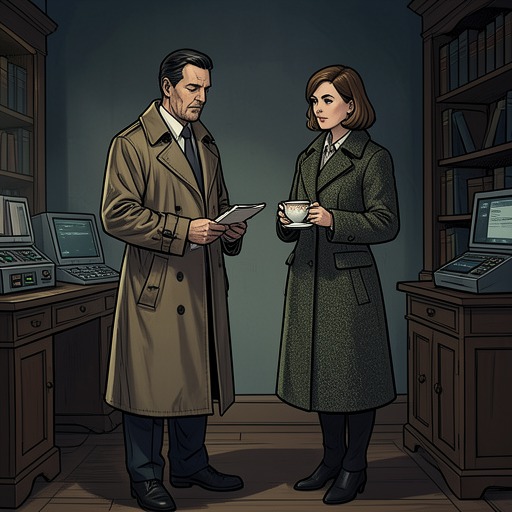
Middleshire Police
A Murder Is AnnouncedMiddleshire Police is the county force responsible for investigating the shooting of Rudi Scherz at Little Paddocks. Under Chief Constable George Rydesdale and Detective-Inspector Dermot Craddock, its inquiry tests witness accounts against physical conditions at the scene, ultimately revealing that the witnesses’ apparent sight of an armed intruder did not correspond to what they could perceive in the darkness.
Leadership and investigative approach
George Rydesdale, Middleshire’s Chief Constable, is portrayed as a quiet, observant authority: he listens, then issues brief orders that are obeyed. He recalls Dermot Craddock from Liverpool, where Craddock had been making inquiries on another case, and puts him officially in charge. Rydesdale values not only Craddock’s intelligence and imagination but his discipline: the inspector is expected to proceed slowly, check each fact, and keep an open mind until the investigation is complete.
Craddock begins by proposing a sequence of inquiries: first the Royal Spa Hotel in Medenham Wells, where Rudi Scherz worked as a receptionist, then Chipping Cleghorn, where Sergeant Fletcher is already interviewing people connected with the case. He also identifies Constable Legg’s prompt response to the emergency call as effective despite the confusion of a dozen people trying to speak at once. This division of work gives the inquiry both a local investigative presence and a route for checking Scherz’s identity and employment beyond the house where he died.
Witness evidence and perception
The force’s central difficulty is not simply collecting testimony but determining what the witnesses could have perceived. A preliminary medical report establishes that the revolver was fired at close range, with singeing, but does not decide whether the discharge was accidental or deliberate. Rydesdale therefore directs Craddock to question the witnesses carefully and establish exactly what each one saw. Craddock expects their accounts to differ, while Sir Henry Clithering points to the pressure of intense excitement as a reason to examine both what people notice and what they miss.
The accounts initially seem to converge on a masked man with a revolver and a torch entering the room and holding everyone up. Craddock states this consensus as if it were conclusive, but the inquiry tests it against the lighting. The intruder’s powerful torch was dazzling, and the darkness outside the room meant that the witnesses could not make out the person holding it. Their later descriptions can therefore reflect what they reconstructed after the lights came on, rather than a clear view during the hold-up. The distinction between sincere testimony and reliable observation becomes essential to the investigation.
Testing the scene and its clues
Craddock’s methods include examining the premises rather than relying on recollection alone. At a seldom-used door, he finds a rusty collection of keys in a hall drawer, selects one that looks different, and discovers that it fits and turns easily. The door then slides open noiselessly. The discovery prompts concern that something might be resting behind it, but it also gives the inquiry a concrete feature of the house to test against the accounts of movement and access.
The investigation also reconstructs how the apparent blackout was produced. The lamp’s cord had been frayed until its wires were nearly bare; when Letitia Blacklock lifted the vase of violets and spilled water over the exposed area before switching on the lamp, the wires fused. The close placement of the vase, cigarette-box, and switch made the act brief and easy to conceal amid the staged commotion. This physical explanation turns a supposed interruption into a mechanism that could be examined and connected to the sequence of actions in the room.
From investigation to reconstruction
Craddock is also present when testimony and memory are reconsidered together. Miss Marple explains how Miss Murgatroyd’s confused, self-contradictory manner need not mean that she remembered nothing: she could retain particular visual details without at first understanding their significance. Recalling an earlier railway accident and a flying bomb in London, Marple distinguishes the small things a person notices under shock from the interpretation later imposed on them. The police inquiry gains a crucial lead by treating the witness’s uncertainty as something to investigate, not as a reason to discard her account.
That reconstruction locates Miss Murgatroyd’s attention along the path of the torch and culminates in an absence: when the shots were fired, the place where Letitia Blacklock was later understood to have stood was empty. The significance of the witness’s remembered scene emerges only when its positions and sequence are reconsidered. Together, the medical report, the lighting conditions, the movable access points, and the damaged lamp show the force’s investigative task at its most exacting: separating observed facts from the explanations witnesses—and investigators—initially attach to them.